back
Camera sensor direct projection
from AO/Reichert tube lens
background
Having sorted that Biophot/Metaphot, Eclipse and AO/Reichert heads
have roughly compatible circular dovetails,
a next question is how compatible are various infinity objects and tube lenses.
When I started, nice used AO Series 10 were plentiful at relatively low cost,
with the U.S. medical industry replacing them (mostly by Olympus microscopes).
I scored a cheap set of MEIJI S.PlanM objectives,
which sufficed for magnified image digital processing experiments,
although Olympus SPlan M objectives were more popular.
All other things being equal, better results obtain from simpler configurations
(e.g. finite objectives directly projecting to camera sensors),
but modern high quality metallurgical objectives are more often infinity.
While Nikon CFI60 objectives are well-regarded,
they are expensive and I lack compatible nosepiece turrets.
Meanwhile, other modern infinity objectives have RMS threads,
with at least Nikon BE and those from Olympus requiring no corrections.
To minimize photo tube vignetting and obtain camera parfocality,
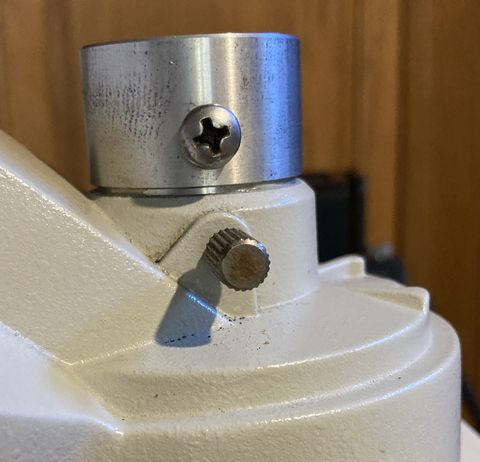
a plastic drain tube section fits outside the photo port,
using Reichert trinocular head's second screw hole,
not found on similar AO heads:
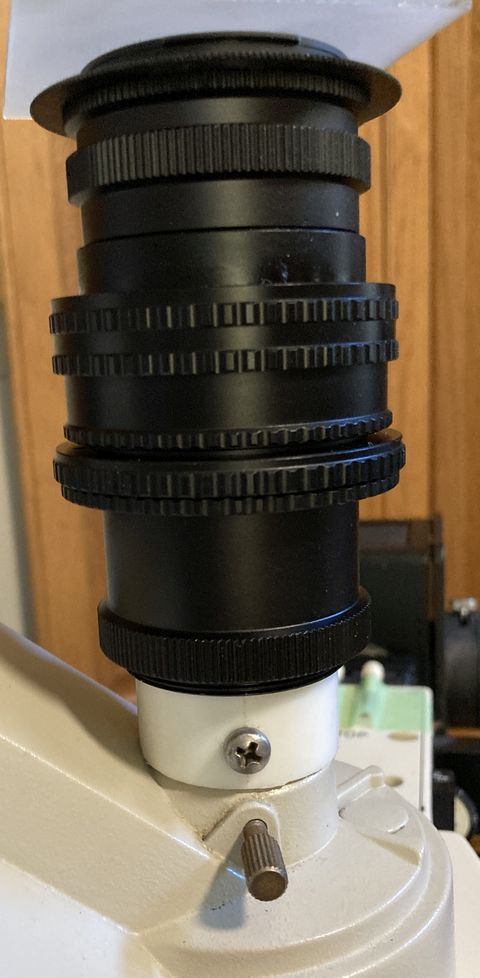
Trinocular microStar heads have approx 25 tube lens diameter,
vs 14mm in Series 10. Reichert trinocular has fixed split,
while One-twenty microStar toggles 100% eye tubes <-> photo port.
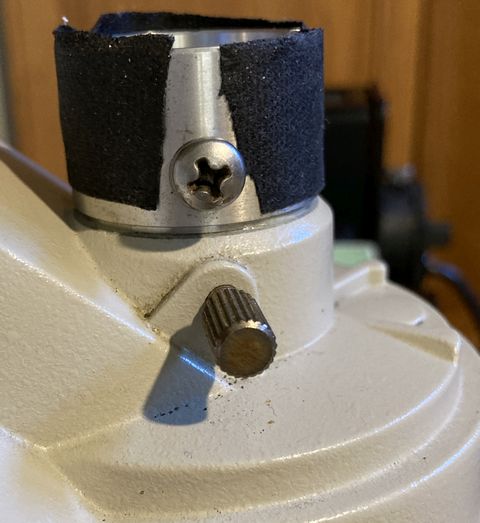
Friction tape reduces slack between photo port o.d. and drain tube i.d.:
Sandpaper removed glaze inside drain tube,
then matte black sprayed to attenuate stray light:
A generic M42 extension tube fits over the drain tube.
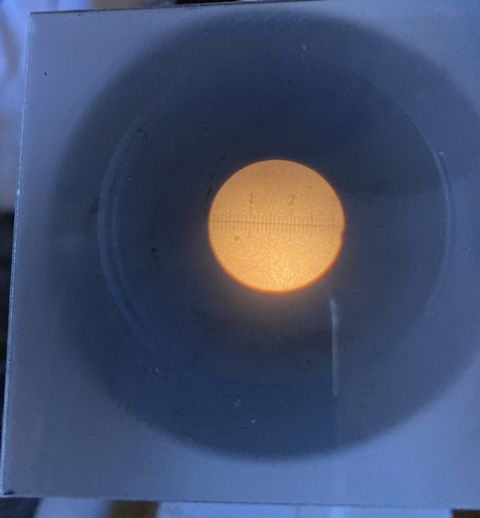
Parfocality employs an M42 focusing helicoid,
first roughly set by projecting calibration slide on ground glass:
Crime scene

"Direct" projection from infinity objectives via AO/Reichert tube lens;
α7R II full frame 35mm camera for more image circle than APS-C;
USB captures by Sony Imaging Edge Desktop™.
|